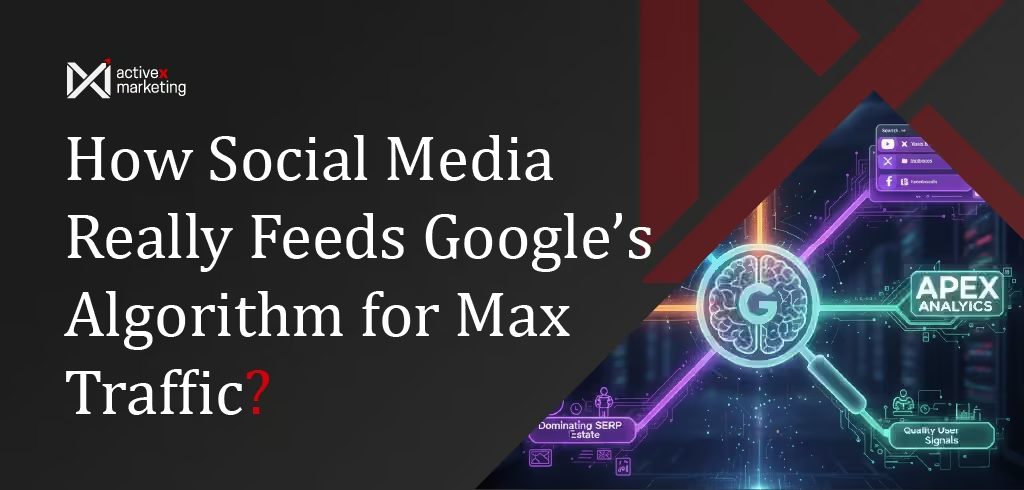
How Social Media Really Feeds Google’s Algorithm for Max Traffic
The old argument over whether social media directly impacts Google rankings is tired—and largely irrelevant. Google does not count your likes or shares as a direct ranking signal, but that completely misses the point. Social media is the single most powerful content amplifier and authority builder at your disposal, fueling the exact direct signals (like traffic, backlinks, and brand searches) that do skyrocket your position on the Search Engine Results Page (SERP). This is how you stop writing content that dies in the dark and start earning digital gold.
You’ve done the work. You spent thirty hours researching, writing, and optimizing a masterpiece of a blog post. It's got the perfect H1, the ideal keyword density, and a killer meta description. You hit 'Publish,' and then you wait. A week later, you check Google Analytics: crickets. Your content is a ghost ship, drifting in the vast ocean of the internet.
Why? Because even the most optimized content needs a megaphone to be heard. You can’t wait for Google to find your tiny beacon in the noise; you need to drive a convoy of high-quality, relevant eyes straight to it. Social media isn't a distraction from your SEO game—it’s the nitrous boost that makes your on-page work finally pay off.
Stop Debating, Start Executing
Forget what you think you know. Here are the facts that should re-route your budget today:
💥 A Hootsuite study showed that articles with the highest social shares saw an average of a 22% increase in SEO results. This isn't a coincidence; it's correlation driven by causation. Social activity causes the events that Google rewards.
💡 More critically, nearly one in three consumers (and 41% of Gen Z) are skipping Google altogether, starting their product and knowledge searches directly on social platforms like TikTok and YouTube. Your audience is already searching—if you aren't optimized there, you're invisible to a massive, high-intent segment.
The Four Pillars of Social SEO Power
The link between social media and SEO is an indirect, but crucial, engine. Think of your website’s content as the high-octane fuel; social media is the global distribution network that gets that fuel to the right people.
Here is the breakdown of the four critical ways social media directly manipulates your search rankings:
1. Content Amplification & The Backlink Gold Rush
This is the non-negotiable standard. Google treats backlinks (links from high-authority, relevant external sites) as votes of confidence. The more authoritative the votes, the higher your rank. But how do you get those links?
The Mechanism: A post you share on LinkedIn or X goes viral, catching the eye of a journalist or an industry blogger. They love the data you presented and reference it in their next article, linking back to your original source.
The Example: You publish an infographic on $X$ titled "The 2025 State of Remote Work." A high-profile SaaS company with a Domain Authority of 80 sees it, cites your data in their weekly newsletter, and drops a high-value backlink to your site. That single backlink is worth 1,000 times the effort of a single social post. Result: A direct and massive spike in your page’s authority in Google's eyes.
2. Branded Search Volume: The Trust Signal
Search engines like Google don't just measure what keywords you're optimizing for; they measure your brand's authority and popularity. When a customer explicitly searches for your brand, it's the strongest possible signal of trust.
The Mechanism: You consistently run witty, engaging campaigns on Instagram and YouTube. Your audience begins to trust you as an expert. The next time they have a problem your product solves, they don't search "best CRM," they search "[Your Brand Name] CRM review."
The Example: Your company, "Apex Analytics," posts a daily, insightful data visualization on X. Users constantly search "Apex Analytics" on Google. Google sees this increase in branded search volume and thinks, "This brand is highly trusted and relevant. We should prioritize their content for broader, related searches." Result: You start ranking for generic, high-volume keywords like "analytics tools" simply because of your overwhelming brand presence.
3. Driving Quality User Signals: Lowering the Bounce Rate
Google is obsessed with user experience. If people click your search result and immediately hit the back button (high bounce rate), Google assumes your content sucks. If they stay and read (high dwell time), Google rewards you.
The Mechanism: Social media allows you to perfectly pre-qualify your audience. When you share a link, you’re hitting the exact segment that wants that content. The traffic you get from a targeted Facebook or LinkedIn group is exponentially higher quality than random organic traffic.
The Example: You share your 5,000-word deep dive on "Advanced Kubernetes Deployment" in a specialized DevOps LinkedIn group. Only highly relevant users click. They spend 7 minutes reading the article. Result: Your average dwell time goes up, your bounce rate plummets, and Google sees this as a clear signal that your page is delivering exactly what searchers are looking for.
4. Dominating SERP Real Estate
Your social profiles themselves are web pages, and they rank. By optimizing your profiles with keywords, you can monopolize the front page of Google for your most critical branded terms.
The Mechanism: When a user searches for your company name, the SERP usually displays your website, your YouTube channel, your LinkedIn profile, and your X feed. This pushes all competitors off the valuable above-the-fold space.
The Example: A user searches "Zenith Financial." The results show: 1. https://www.google.com/search?q=ZenithFinancial.com, 2. Zenith Financial - LinkedIn, 3. Zenith Financial - YouTube, 4. Zenith Financial - X, and 5. Zenith Financial - Facebook. Result: You control 5 out of the top 5 organic spots, creating a "moat" around your brand in search.
The Conclusion: Go from Writer to Authority
The next time someone tells you social media doesn't matter for SEO, remind them of the fundamental truth: SEO is a popularity contest, and social media is the loudest microphone on the planet.
Stop viewing your social strategy as a separate department. It's the engine that generates the backlinks, branded trust, and quality user signals that Google fundamentally values. Marry your keyword research with your content promotion, focus on creating irresistible, shareable authority pieces, and you won't just rank higher—you'll own the conversation. Now go build that digital gold.
Frequently Asked Questions
Here are the answers to the questions we hear most often. If you don't find what you're looking for, feel free to contact us directly—we're happy to help.
Does social media directly affect Google's search ranking algorithm?
No. Google has officially stated that social signals (likes, shares, comments) are not a direct ranking factor for their core algorithm.
How, then, does it play a vital role in my SEO?
It plays a crucial indirect role. Social media amplifies your content, driving highly qualified traffic, increasing brand mentions, and creating opportunities to earn high-authority backlinks—all of which are direct ranking factors.
Does Bing or other search engines use social signals?
Yes. Microsoft Bing has publicly acknowledged that social signals (shares, authority of the sharer, etc.) are a factor in how they rank content.
What is 'Social SEO' in a nutshell?
Social SEO is the practice of aligning your SEO keyword strategy with your social media content and profile optimization to maximize traffic, authority, and content amplification across all channels.
What is the most valuable indirect SEO benefit from social media?
Generating high-quality, authoritative backlinks. A viral share on social media is the quickest way to get your content in front of influential people who can link to your website.
Do social media links (e.g., in a tweet) pass 'link juice' (PageRank)?
Generally, no. Most social media platforms apply a rel="nofollow" or rel="ugc" attribute to external links, telling search engines not to pass authority. However, the traffic and visibility generated are the real benefit.
How does YouTube, as a platform, impact SEO?
YouTube is the second largest search engine. Optimizing video titles, descriptions, and tags with high-volume keywords allows your videos to rank both within YouTube and often on Google’s SERP, dramatically increasing brand visibility.
Should I use my website’s SEO keywords in my social media bios?
Absolutely. Optimizing your profile names, bios, and 'About' sections with your top keywords helps your social profiles rank highly for relevant branded and non-branded searches on both Google and within the social platform itself.
How does user engagement on social media (comments, shares) help SEO?
High engagement signals that the content is highly relevant and valuable. This increases the likelihood of an influencer sharing it, which leads to backlink opportunities, and it encourages branded searches on Google.
Can social media posts show up directly on a Google SERP?
Yes. For branded queries (searches for your company name), your X (Twitter) feed, LinkedIn profile, or even TikTok videos can often be featured directly in the search results, increasing your "SERP real estate."
Does social media help with Local SEO?
Yes. Ensuring your name, address, and phone number (NAP) are consistent across social platforms (especially Facebook, which links to Google Maps) reinforces your local credibility and is an important factor for local search result visibility.
What are the key social media metrics I should track for SEO impact?
Focus on Referral Traffic (visits to your site originating from social platforms), Conversion Rate of Social Traffic, and the Increase in Branded Search Volume in Google Search Console following a major social campaign.


0 Comments