Content Marketing Mastery: The Ultimate Strategy Guide to Drive Growth, Lead Generation, and Revenue
Modern customer acquisition has reached an expensive tipping point, as rising bid costs on major advertising networks yield diminishing returns and banner blindness degrades traditional campaign performance. To build sustainable pipeline and capture high-intent buyers, enterprise brands must shift their focus toward authoritative content marketing that establishes genuine topical trust. Continuing to rely solely on paid acquisition channels creates a highly volatile dependency, where customer generation instantly dries up the moment ad budgets are turned off. Without a structured, compounding organic strategy, organizations waste substantial marketing capital on fleeting impressions rather than building permanent digital assets that accrue equity over time. This comprehensive guide provides a masterclass in designing a high-impact inbound marketing blueprint that aligns directly with buyer intent. We outline the exact frameworks required to build scalable B2B campaigns, implement advanced search engine optimization architectures, and deploy robust attribution models that connect digital publishing efforts directly to measurable company revenue.
What is Content Marketing and Why It Powers Modern Inbound Marketing
Content marketing is a strategic acquisition framework focused on creating and distributing valuable, relevant, and consistent digital assets. Instead of using interruptive advertising, this method addresses specific user search queries to attract, educate, and retain a clearly defined target audience. By offering direct value first, organizations naturally drive profitable customer actions.
Modern consumers actively filter out traditional advertisements through ad-blockers and banner blindness, shifting the purchasing journey toward self-directed research. Organizations must pivot from interruptive tactics to educational resources that answer specific buyer questions. By positioning expertise early in the decision-making cycle, brands build immediate credibility before sales contact is ever initiated.
This value-driven approach serves as the structural foundation of a sustainable inbound marketing strategy. While paid acquisition channels stop delivering results the moment ad spend halts, digital assets continue to capture search traffic indefinitely. Consequently, this methodology constructs a compounding asset portfolio where the cost per acquisition steadily decreases over time.
The Core Pillars of a High-Impact Digital Marketing Framework
An effective digital marketing framework requires absolute alignment between editorial production, search engine optimization (SEO), user experience (UX), and conversion rate optimization (CRO). Failing to integrate these disciplines results in high bounce rates and wasted traffic acquisition. High-ranking pages must load rapidly, display clean visual hierarchies, and present intuitive paths to conversion.
- SEO Integration: Aligning search intent with structured technical optimization, key semantic entities, and precise crawlability.
- User Experience (UX): Designing intuitive layouts, clear typography, and fast loading speeds to retain organic traffic.
- Conversion Rate Optimization (CRO): Deploying contextual calls-to-action that guide users naturally toward the next step in the buyer journey.
Content Marketing vs. Traditional Advertising: Why Pull Beats Push
Consumer psychology heavily favors educational discovery over forced promotional messaging. Intrusion-based marketing models trigger immediate cognitive resistance, causing users to ignore promotional banners and sponsored links. Pull marketing strategies circumvent this friction by answering questions that users are actively searching to solve.
| Feature | Pull Marketing (Content Assets) | Push Marketing (Traditional Advertising) |
|---|---|---|
| User Intent | High-intent, self-directed search queries | Interrupted attention, low initial intent |
| Longevity | Compounding, permanent organic equity | Temporary, expires when budget ends |
| Cost Dynamics | Declining cost-per-acquisition over time | Fixed or rising pay-per-click bid pricing |
| Trust Building | High credibility through education | Lower trust due to overt commercial bias |
Designing a Modern Marketing Strategy: The Strategic Blueprint
A modern marketing strategy is a structured blueprint that aligns business growth objectives with the specific informational needs of target audiences. It utilizes precise persona research, intent-mapped content pillars, and comprehensive competitive gap analyses. By building this systematic framework, organizations successfully capture high-value search traffic and convert prospects.
Building an operational blueprint requires shifting past basic demographic profiling into deep search intent analysis. Teams must document exactly what questions their prospects ask during operational friction points. By mapping out these pain points, organizations can deploy tailored resources that directly address operational bottlenecks.
Maintaining a strict editorial calendar organized around defined content pillars prevents fragmented publishing patterns. This systematic scheduling ensures balanced coverage of key industry topics while preserving topical authority. Additionally, competitive gap analysis reveals high-volume search terms that industry competitors have addressed with low-quality or outdated material.
Aligning Business Goals with Audience Intent
Every piece of published material must serve both user requirements and organizational revenue targets. To achieve this alignment, search intent must dictate the format and tone of the asset. When a user seeks informational guides, the content should educate objectively while showcasing the organization's unique operational philosophy as the natural solution.
- Informational Intent: Address operational problems with step-by-step educational articles, establishing baseline authority.
- Commercial Intent: Deliver comparison frameworks and feature matrices that help buyers evaluate potential solutions.
- Transactional Intent: Present optimized product demos, ROI calculators, and case studies to finalize the purchase decision.
The Lifecycle of a High-Converting Content Funnel
A high-converting funnel systematically transitions anonymous searchers into qualified sales opportunities. This progression requires specific assets tailored to the varying psychological stages of the modern customer journey. Aligning these pieces prevents drop-offs and increases total pipeline velocity.
- Top-of-Funnel (TOFU): Highly visible blog posts and diagnostic checklists designed to capture broad informational queries.
- Middle-of-Funnel (MOFU): Detailed whitepapers, comparison templates, and webinars that analyze potential operational solutions.
- Bottom-of-Funnel (BOFU): Rigorous product breakdowns, deployment case studies, and proprietary ROI calculation tools that finalize selection.
How to Develop a B2B Content Marketing Strategy That Converts
A B2B content marketing strategy converts by targeting the complex pain points of enterprise buying committees across extended sales cycles. It prioritizes data-backed thought leadership, structured technical resources, and objective solution-evaluation frameworks. This targeted focus builds organizational consensus and eliminates friction among multiple stakeholders.
Enterprise purchasing involves multiple decision-makers across technical, financial, and operational departments. Consequently, B2B assets must address different departmental priorities within a single, unified narrative. Financial stakeholders require clear ROI projections, while technical directors require integration guides and security documentation.
Nurturing cold leads through high-value technical assets helps sustain engagement over long multi-month buying cycles. By regularly distributing objective industry research, brands keep prospects engaged without resorting to aggressive sales tactics. This steady build-up of topical trust ensures the brand remains top-of-mind when the purchasing window opens.
Map Content to the Buyer's Journey (Awareness, Consideration, Decision)
Addressing friction points systematically requires mapping specific assets to each critical phase of the enterprise pipeline. This alignment ensures that sales reps can deploy highly targeted collateral whenever prospects raise operational objections. Consequently, deals progress faster through the conversion pipeline.
- Awareness Phase: In-depth technical guides that address systemic industry inefficiencies and regulatory shifts.
- Consideration Phase: Detailed whitepapers and architectural blueprints demonstrating how to deploy complex solutions.
- Decision Phase: Direct client case studies showing proven cost-reduction metrics and rapid implementation timelines.
Creating Authoritative Blog Posts that Position Your Brand as an Industry Leader
Publishing high-ranking blog posts requires a strict focus on depth, original data, and clear structural hierarchy. Search engine algorithms prioritize pages that demonstrate authentic experience and expertise through original research. To satisfy both search engines and human readers, content must integrate clear semantic headings and explicit metadata schema.
- Original Data Integration: Include proprietary survey statistics or corporate case results to earn organic backlinks.
- E-E-A-T Frameworks: Feature insights and direct quotes from internal subject matter experts to establish real-world authority.
- Schema Markup: Implement article and product schema to help search engines parse the core entities correctly.
Leveraging Social Media for Distribution and Brand Authority
Distributing corporate collateral requires a proactive strategy that extends far beyond simple link sharing. Industry leaders publish native, value-dense updates directly on professional networks like LinkedIn to capture attention where decision-makers already congregate. Converting longer publications into short, readable summaries drives immediate engagement without forcing a platform exit.
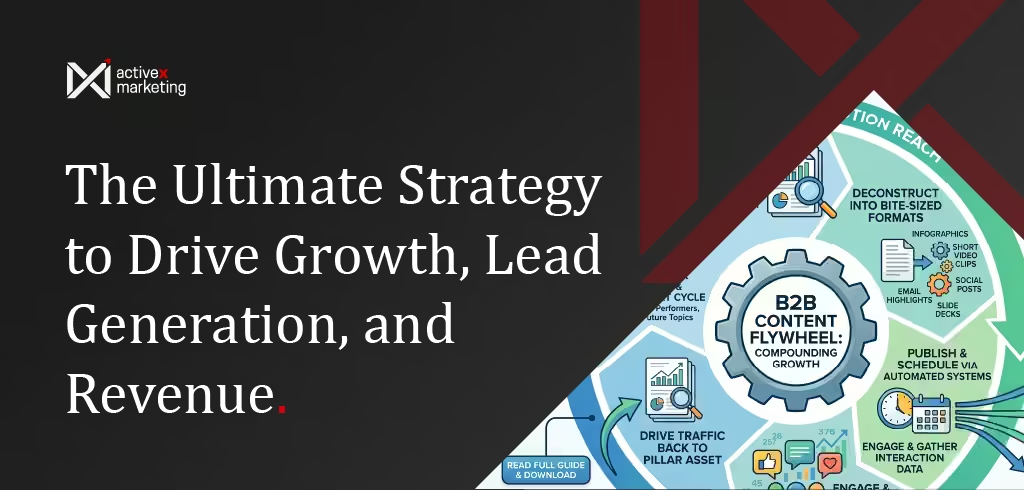
[MEDIA DIRECTIVE]: [Insert an interactive infographic or a detailed workflow diagram showing a 'B2B Content Distribution Flywheel.' The visual must map out how a single comprehensive blog post is repurposed into micro-content for social media platforms, email newsletters, and slide decks, illustrating the compounding distribution reach.]
Scaling Growth with Effective Content Marketing Techniques
Effective content marketing techniques scale growth by structuring digital assets into interconnected semantic frameworks. This strategy includes deploying the hub-and-spoke (topic cluster) architecture and performing systematic historical optimizations of existing content. Additionally, creating interactive tools satisfies specific user search intent to drive sustained conversions.
Scaling organic traffic requires moving beyond isolated asset production to build highly organized, interconnected structures. Search engines evaluate the authority of an entire website based on its depth of coverage on a given topic. By systematically grouping related resources, organizations signal comprehensive expertise to search engine crawlers.
Furthermore, updating legacy content is often more efficient than creating new assets from scratch. Historical optimization refreshes outdated statistics, updates broken links, and refines targeting for changed search intent. This upkeep rapidly restores declining rankings and extends the lifespan of historical publication investments.
The Hub-and-Spoke Model for Maximum SEO Authority
The hub-and-spoke model organizes information into clear thematic categories that simplify site crawling and indexation. A single, comprehensive pillar page provides a high-level overview of a broad topic, while linking directly to detailed supporting spoke articles. This structured internal linking distributes authority evenly throughout the domain.
- Pillar Pages: Broad, authoritative guides that cover an entire subject landscape and establish primary topical relevance.
- Spoke Articles: Hyper-targeted pages addressing long-tail search queries linked directly back to the pillar.
- Anchor Text Optimization: Using descriptive, keyword-rich internal anchor text to distribute page authority throughout the domain.
Repurposing Assets into Multiple Formats (Video, Infographics, Podcasts)
Maximizing the return on production investments requires transforming single written works into multiple media formats. Different buyers consume information through varying channels, making multi-format delivery key for maximum market penetration. Repurposing also extends the lifetime value of initial research.
- Video Adaptations: Transform high-performing tutorials into step-by-step video guides for visual learners.
- Visual Infographics: Condense dense data points and comparative tables into easily shareable graphic summaries.
- Audio Podcasts: Adapt long-form strategic essays into narrative audio formats for on-the-go professionals.
Navigating Content Marketing Services for Small Business
Content marketing services for small business provide professional execution models designed to scale organic traffic on limited budgets. These services include partnering with specialized digital marketing agencies or utilizing vetted freelance networks to draft detailed briefs and optimize organic search. These options allow lean teams to execute structured campaigns efficiently.
Small businesses must choose execution models that balance budget realities with consistent production schedules. Outsourcing to external specialists often provides access to specialized tool suites and diverse editorial talent. However, internal coordination remains necessary to protect brand voice and ensure technical accuracy.
Drafting comprehensive content briefs is the most reliable way to maintain quality standards across outsourced teams. These documents must explicitly define target audiences, preferred formatting styles, primary search keywords, and internal style constraints. Additionally, organizations must anticipate realistic implementation timelines, as organic channels require several months to mature.
In-House vs. Outsourced Agencies: Evaluating Your ROI
Evaluating internal hiring against agency partnerships requires comparing total overhead, software costs, and production capacity. While internal teams offer deep product familiarity, agencies provide immediate, multi-disciplinary expertise without the burden of full-time employee benefits. Organizations must analyze these dynamics to protect marketing budgets.
| Operational Dimension | In-House Content Team | Specialized Digital Agency |
|---|---|---|
| Direct Overhead Costs | High (salaries, benefits, dedicated workspace) | Variable (predictable monthly retainer fees) |
| Specialized Tool Access | Expensive individual enterprise subscriptions | Included in standard service delivery |
| Scaling Velocity | Slow (limited by recruiting and training speed) | Immediate (access to scaled expert writers) |
| Strategic Management | Internally driven, consuming leadership time | Structured and managed by external PMs |
Essential Bootstrapped Tools for Execution and Analytics
Executing an effective campaign on a restricted budget is achievable through a curated stack of modern, affordable tools. These platforms streamline keyword tracking, editorial optimization, design creation, and performance reporting. Utilizing free resources allows small enterprises to build authority cost-effectively.
- Google Search Console: Essential free tool for monitoring keyword positions, indexation health, and organic search impressions.
- Canva: User-friendly platform for designing custom article banners, social graphics, and downloadable templates.
- AnswerThePublic: Invaluable resource for mapping real-world long-tail user questions and search intent patterns.
Measuring ROI: Transforming Content into Lead Generation Engines
Measuring ROI transforms digital assets into measurable lead generation engines by directly connecting organic traffic to pipeline value. This process requires setting up conversion goals in Google Analytics 4, deploying contextually relevant calls-to-action, and tracking concrete pipeline metrics. By focusing on these indicators, organizations tie marketing spend directly to revenue.
Shifting focus away from superficial metrics like pageviews is necessary for validating organic marketing investments. Instead, operations teams must track direct contributions to pipeline growth and customer acquisition values. High traffic levels are meaningless if the visitors do not match client profiles or convert into actionable leads.
Configuring exact custom conversion goals within Google Analytics 4 (GA4) isolates high-performing channels. This direct monitoring allows teams to identify which specific pieces of writing drive sign-ups and contact requests. Furthermore, displaying customized, intent-mapped lead magnets drastically increases visitor conversion rates.
Key Performance Indicators (KPIs) That Actually Matter
Evaluating campaign effectiveness requires tracking a precise set of actionable operational metrics. Focusing on these indicators ensures that editorial decisions directly support broader corporate growth goals. This data-driven tracking replaces assumptions with cold operational facts.
- Organic Search Growth: Consistent increases in high-intent keyword rankings and overall organic domain traffic.
- Click-Through Rate (CTR): The efficiency of metadata headlines and descriptions in driving search click-throughs.
- Conversion Rate: The percentage of visitors completing critical actions, such as downloading assets or filling out forms.
- Customer Acquisition Cost (CAC): The total investment divided by new customers, demonstrating long-term cost efficiency.
Attribution Models: Connecting Content Direct to Revenue
Accurately tracking client journeys requires implementing advanced attribution models within enterprise systems. Because typical buying cycles involve multiple touchpoints across several weeks, simple single-touch tracking often misattributes revenue. Multi-touch attribution models distribute transaction credit fairly to early-stage educational assets.
[MEDIA DIRECTIVE]: [Embed a clean, high-contrast visual comparison table comparing 'Vanity Metrics vs. Actionable Business Metrics.' The left column should list common metrics (e.g., pageviews, likes) and why they can mislead, while the right column lists the corresponding business metric (e.g., scroll depth, conversion rate, pipeline value) to focus on.]
Securing Sustainable Market Dominance Through Organic Equity
Modern customer acquisition demands a transition from rented attention to owned digital assets. Relying exclusively on paid campaigns creates an expensive, volatile cycle where client acquisition halts the moment ad spend freezes. Conversely, establishing a sophisticated, data-driven content marketing architecture builds compounding search equity, driving sustainable organic traffic, reducing customer acquisition costs, and accelerating total pipeline velocity.
Ignoring this strategic evolution risks surrendering dominant search rankings and market share to more agile, authoritative competitors who prioritize educational value over interruptive messaging. To lead these complex inbound initiatives and drive enterprise growth, digital marketing leaders and corporate teams must master the advanced technical mechanics of search engine optimization, user behavior analysis, and multi-touch conversion attribution.
Ensure your organization is equipped with the necessary methodologies to execute these high-performing strategies. Validate your technical expertise, upskill your internal teams, and advance your career by enrolling in industry-recognized professional certification training programs through iCertGlobal. Secure your market authority and transform your digital publishing efforts into high-converting revenue engines.
Frequently Asked Questions
Here are the answers to the questions we hear most often. If you don't find what you're looking for, feel free to contact us directly—we're happy to help.
What is the difference between content marketing and inbound marketing?
Content marketing is a tactical subset of inbound marketing focused on creating and distributing valuable assets to engage audiences. In contrast, inbound marketing serves as the overarching marketing strategy, integrating SEO, social media, email nurturing, and CRM systems to convert those prospects into customers.
How long does it take to see results from content marketing?
Content marketing is a long-term digital marketing investment that typically requires three to six months to generate measurable search rankings and organic traffic. However, compounding growth and revenue conversions scale significantly after twelve months of consistent publishing and continuous technical optimization.
What are the most effective content marketing techniques for lead generation?
The most effective content marketing techniques for lead generation focus on capturing high-intent search traffic through targeted conversion points: * **Ungated High-Value Assets:** Provide free templates, checklists, or interactive tools to build initial brand authority. * **Gated Resources:** Offer comprehensive whitepapers, e-books, or webinars behind optimized lead-capture forms. * **Contextual Calls-to-Action (CTAs):** Insert highly relevant mid-post CTAs that align directly with user search intent. * **Exit-Intent Popups:** Deploy personalized content offers when users signal their departure from the page.
How do small businesses execute a content marketing strategy on a budget?
Executing budget-conscious content marketing services for small business requires a hyper-focused operational roadmap: 1. **Target Longtail Keywords:** Prioritize low-competition, high-intent phrases to secure fast search engine visibility. 2. **Prioritize Quality Over Quantity:** Publish one or two high-impact, comprehensive assets monthly rather than daily low-quality posts. 3. **Repurpose Core Assets:** Convert single blog posts into newsletter segments and social media threads. 4. **Leverage Free Tools:** Utilize Google Search Console and Canva to handle keyword analysis and visual design in-house.
Why is a B2B content marketing strategy different from B2C?
A B2B content marketing strategy targets complex, multi-stakeholder buying committees with logic-driven, ROI-focused resources over long sales cycles. Conversely, B2C content marketing appeals directly to individual consumer emotions to drive immediate, low-friction transactional conversions through simplified decision-making pathways.





0 Comments